Wednesday, November 30, 2011

Tutorial Critique 3: Eyes

I went to YouTube for this tutorial . I chose YouTube because wanted to see how a video based tutorial stacked up against one with still images. Interestingly enough, they’re quite similar, the main difference being that videos allow for audio (I would also say moving frames, but artists could use a gif for image progression). Again, I will give a little info on the artist. He went to New England Institute of Art, he has several sites that he uses to showcase his work (which in my opinion is excellent). For those interested, his sites are on YouTube, deviantART, and Blogger .

On to my critique of the tutorial.

Pros


  • He shows visual progression.

  • The text is short and concise.

  • He accepts criticism, and allows feedback from his viewers.

  • The final product looks good (in my opinion), suggesting he knows what he’s talking about.

Cons


  • The text doesn’t go too much into detail about how he does what he does.

  • From what I can tell, the tutorial is more for people who already have an understanding of how to draw an eye. So this isn’t really for beginners.

  • He skips how he did his line art, which some people might find helpful (though he does link to a previous tutorial he’s done that goes over how to draw the eye from scratch).

  • The audio consists solely of background music. This isn’t necessarily a con. Some viewers may find it enjoyable, others may not.

  • The title is a little deceptive. The tutorial is more focused on shading the eye, rather than drawing.

The tutorial is helpful, but like I said before, not for beginners. An artist has to understand how shadows and lights fall onto the eye (or any subject) for them to fully take anything from the tutorial. Although to his credit, I am not a beginner, and I don’t think I have ever drawn an eye as good I have before following this tutorial.

Here is my product.
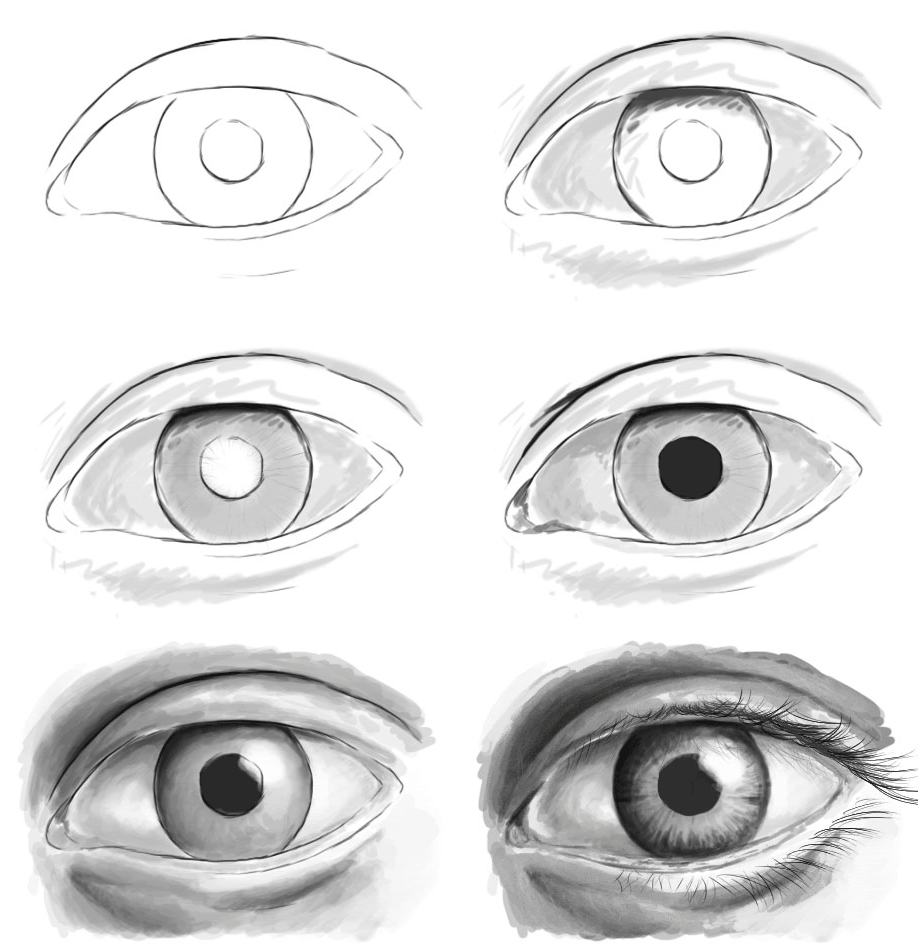
Eye Progression

© All rights for the above image reserved

Cited Works


coldsnapkiller. (2011). 1.gif picture by coldsnapkiller. Retrieved November 29, 2011 from http://s1098.photobucket.com/albums/g371/coldsnapkiller/?action=view¤t=1.gif

Isaiah. (2011). Eye Drawing Tutorial. Retrieved November 29, 2011 from http://www.youtube.com/watch?v=AvKBWaOQ28M

Isaiah. (2011). IsaiahKS on deviantART. Retrieved November 29, 2011 from http://isaiahks.deviantart.com/

Isaiah. (2011). isaiah's Channel - YouTube. Retrieved November 29, 2011 from http://www.youtube.com/user/isaiahs

Isaiah. (2011). Sick Sad Story :). Retrieved November 29, 2011 from http://isaiahks.blogspot.com/

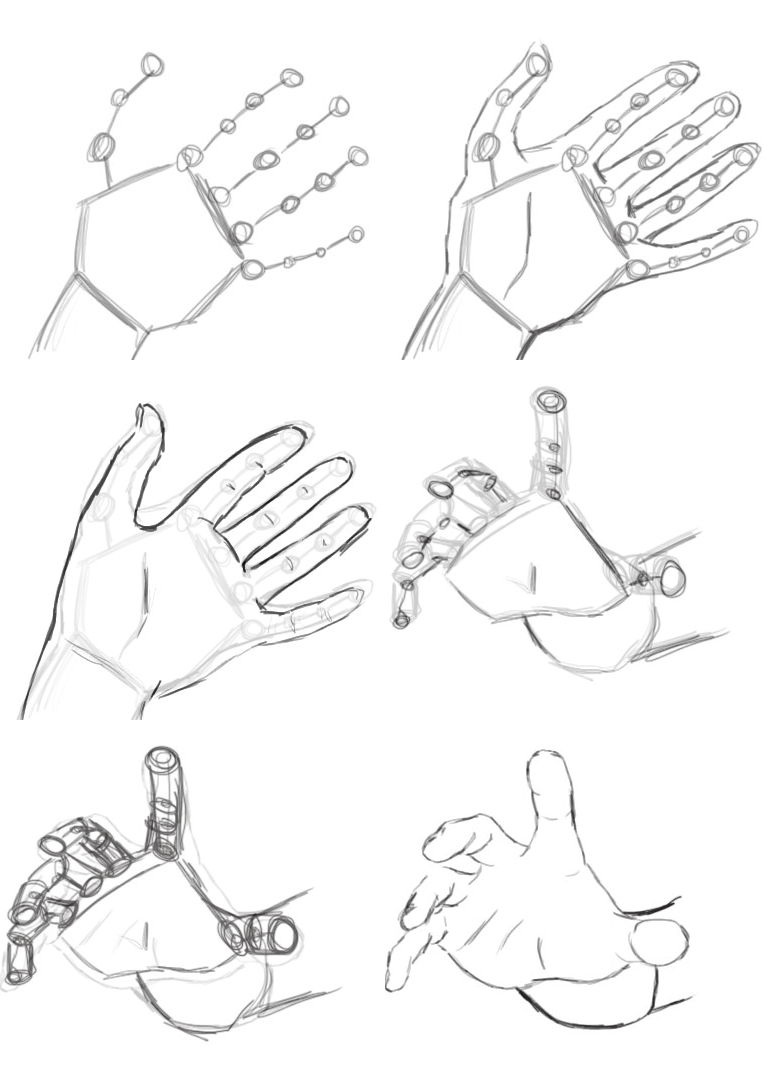
Tutorial Critique 2: Hands

The tutorial for this post will focus on hands. I chose to do a tutorial on hands because I myself have had trouble with drawing them in the past, and sometimes struggle with them today.

The particular tutorial I am following comes from a site called Rate My Drawing. The tutorial was created by KakeranoTsuki (screen name). A little on the artist—from what I could gather— she is 19 years old, and based on how long she’s been a member of the site (along with her deviantART account), she has quite a bit of experience in drawing. Given that, I trust that Tsuki has an idea of what she’s talking about in her tutorial.

Now, for my thoughts on the tutorial.

Pros

  • Her steps are short and concise, so becoming confused shouldn’t be an issue even for a beginner.
  • When she uses art jargon, like foreshortening, she explains the idea and gives examples.
  • Each step has a visual.
  • When discussing how to draw fingers, she explains how to draw for both male and female. This is good for the fact that men and women do have differently shaped fingers, so it’s essential she teach the people following her tutorial that for future use.
  • She went into detail about fingernails. It’s just a nice add on for those who want more realistic hand drawings.

Cons

  • There is no comment section, so users can’t suggest changes if any are needed. Though this is more of a site issue.

Since the tutorial has more pros than cons, I give my stamp of approval. The tutorial was effective in teaching someone how to draw hands.

For those who are interested, here is my effort from following the tutorial.

Hand In Progress

© All rights for the above image reserved

Cited Works


coldsnapkiller. (2011). 1.gif picture by coldsnapkiller. Retrieved November 29, 2011 from http://s1098.photobucket.com/albums/g371/coldsnapkiller/?action=view¤t=hand.gif

KakeranoTsuki. (n.d.). Tips for drawing hands. Retrieved November 29, 2011 from http://www.ratemydrawings.com/tutorials/drawing/138-Tips_for_drawing_hands.html

KakeranoTsuki. (2011). KakeranoTsuki on deviantART. Retrieved November 29, 2011 from http://kakeranotsuki.deviantart.com/

Mixart New Media LLC. (2011). Rate My Drawing. Retrieved November 29, 2011 from http://www.ratemydrawings.com/index.php

Tuesday, November 29, 2011

Color Use

Tutorials for color use are one of many art tutorials available. When opting to use color in a piece the artist is presented with different challenges than they would face when dealing solely with the grey scale.

Stone says that “[o]ne ideal goal would be that the reproduction is indistinguishable from the original.” (2003, p.88) The artist has to realize that the ways colors appear in person aren’t always the way they should be transferred to paper. I have learned from teachers and from personal experience that one should not use pure green to color in the leaves, grass, or what have you. By blending “small patches” of color (particularly colors that would normally go unnoticed) can create a more realistic rendition of the subject matter. (Kuehni, 2005, p. 155)For example, skin tones are composed of more than browns, tans, and peaches—blues, reds, and greens may also be present, but because the colors are so subtle they go unnoticed.

The artist has to be aware of and consider complementary colors. Complementary colors are “colors directly opposite each other in the color spectrum”. (Oxford University Press, 2011) By blending a colors complement (red for green, yellow for purple, and blue for orange) the artist can create darker hues of the various colors. Doing this is a good alternative to using straight black.


Color can also assist when the artist is trying to convey emotion or send a message. Colors have meaning, and each color represents something. The meaning behind a color can vary from culture to culture, i.e. red can stand for rage or love, yellow could stand for happiness or caution, and so on. (Morton, 2011) (The International Business Edge, 2011) The artist has to be conscientious when deciding to use color in this manner.


Cited Works


The International Business Edge. (2011). Color Meanings by Culture. Retrieved November 28, 2011 from http://www.globalization-group.com/edge/resources/color-meanings-by-culture/

Sakurambo.(2007). Blue Yellow Red Color Wheel.[PNG Image]. Retrieved November 29, 2011 from >http://en.wikipedia.org/wiki/File:BYR_color_wheel.svg

Kuehni, Rolf G. (2005). Color an Introduction to Practice and Principles.

Morton, J.L. (2011). Color Matters. Retrieved November 29, 2011 from >http://www.colormatters.com/color-symbolism/the-meanings-of-colors

Oxford University Press. (2011). Definition of Complementary Colors from Oxford Dictionary Online. Oxford Dictionaries. Retrieved November 29, 2011, from >http://oxforddictionaries.com/definition/complementary+colors?region=us

Stone, Maureen C. (2003). A Field Guide to Digital Color.

Monday, November 28, 2011

The Human Form

In the art world, drawing the human figure is arguably one of the more difficult things an artist can learn. The human figure varies greatly from person to person, not only that but one has to understand how the human form works and moves. A human figure drawn with its head twisted around isn’t considered accurate is it? A human figure with one arm two inches shorter than the other isn’t considered in proportion, right? Of course not. Mike Mattisi says, “The human figure is full of force—no matter how still it may seem.” (2006, p. 1) Meaning the body has weight, the body has emotion, and it is up to the artist to accurately depict that when drawing the figure.

The internet is littered with a multitude of tutorials that take the time to teach a newcomer (and those with experience who simply want to learn more) to draw the human figure. Some may go to the extent to teach the artist how to draw the entire human form (Li, 2001). Artists also provide tutorials that teach other artists how to draw individual parts of the human form. (Medlej, 2009)(Julie, 2006) The broken down tutorials of the human form are for artist that have trouble (or simply want to better develop) with the individual body parts, i.e. than hands, feet, head, and so on.
There are various shortcuts to drawing the human figure that I have learned over the years such as:


  • A standing human figure is typically seven heads long (though fashion designers use eight to nine to accentuate the clothes).
  • Foot proportion can be determined by the length of the points from the wrist to the elbow.
  • The face (chin to eyebrows) is proportionate to the tip of the middle finger to the wrist.
  • Simple shapes can help establish early on what an artist wants the human figure to portray, i.e. using inverted triangles for athletic figures, or hourglasses for a more feminine feel (Mattisi, 2008, p. 72)


The human form is a complicated structure and takes time to render with satisfactory results.

Cited Works


Julie. (2006). -Foot Tutorial-. Retrieved November 28, 2011 from http://odduckoasis.deviantart.com/art/Foot-Tutorial-38271036

Li, William. (2001). Figure Drawing: Basic Pose and Construction. Retrieved November 28, 2011 from http://www.elfwood.com/farp/figure/williamlibodyconstruction.html

Mattesi, Mike. (2008). Force: Character Design from Life Drawing. Focal Press.

Mattesi, Mike. (2006). Force: Dynamic Life Drawing for Animators. Focal Press.

Medlej, Joumana. (2009). Drawing Hands. Retrieved November 28, 2011 from http://www.cedarseed.com/fire/handstut.html

Sketching

Learning how to draw has its own difficulties like any other discipline, and like any other discipline it is a good idea to jot down basic ideas. These basic ideas in the drawing world are sketches. A sketch is a “rough or unfinished drawing” which serves as a preliminary blueprint for a more finished piece. (Harper, 2011)(Oxford University Press, 2011) However, making a blueprint is only one of various purposes one can utilize sketches for. Along with the jotting ideas down for later pieces, sketches can also be used for “expression of ideas, time saving expedient, [and] detail clarification.” (Dade County Public Schools,1972) Also while one sketch can be useful “a collection of sketches is more informative.” (Edwards, 2008, p.72)Since sketching is just a rougher, quick, unfinished drawing, the steps for sketching are generally the same. Those steps being: (Wang, 2002, p.39)

  • See
  • Identify
  • Isolate
  • Simplify
  • Translate

Simply, that’s the step that sets a finished drawing from a sketch. Drawings tend to be more elaborate (a bit depending on the skill level of the artist, but generally when coming from the same artist their finished drawings are more elaborate than their sketches) —sketches are simple.

On another note, one does not always have to sketch directly from life. Sketching from memory is also acceptable. Sketching from memory presents problems that sketching from life doesn’t have. Memory sketching requires a “resourceful memory bank”. (Wang, 2002, p.85)When sketching from life something concrete can be referenced and look back to, but when doing the same from memory there are no tangible references, instead the artist has to recall imagery from past experiences and so on.

Cited Works


Dade County Public Schools, Miami, FL.(1972). Orientation, Sketching, Mechanical Drawing, Drafting Basic. :[Washington, D.C.] : Distributed by ERIC Clearinghouse

Edwards, Brian. (2008). Understanding Architecture Through Drawing. Taylor & Francis.

Harper, Douglas. (2011). Sketch. Online Etymology Dictionary. Retrieved November 28, 2011, from http://oxforddictionaries.com/definition/sketch

Oxford University Press. (2011). Definition of Sketch From Oxford Dictionary Online. Oxford Dictionaries. Retrieved November 28, 2011, from http://oxforddictionaries.com/definition/sketch

Wang, T. C. (2002). Pencil Sketching. John Wiley & Sons, Inc.