Friday, December 2, 2011

Podcast Interview With Aaron

For today's post I thought it would good to have an interview, with actual audio of the interviewee.

I apologize in advance for any audio issues, my equipment wasn't high quality. If having trouble with podcost on blogger I provided a link to the audio in the cited works section.


Cited Works


zSHARE. (2011). 1202112333a.qcp. Retrieved December 2, 2011 from http://www.zshare.net/download/96899572198f1815/

Guest Blogger (Jennifer): Tutorial Critique 5: Optimus Prime Line Art

Hello readers of Drawing Better Everyday, my name is Jennifer. And I'll be doing a guest blog for today. This tutorial will be over how to draw Optimus Prime from the new Transformers movies.

I found this tutorial while skimming around websites for anything that would catch my interest.

Pros

  • The tutorial is about Optimus Prime.
  • The tutorial ha images that go along with the steps.
  • The steps in this tutorial are pretty basic.
  • This could be used for any art medium, whether it be digital or traditional.
  • The final product has a really nice look to it.

Cons

  • The tutorial is almost too simple
  • It doesn't provide a level of skill an artist is required to do this.
  • The artist is very, very vague on the steps. One step was details, and then next step was just “more details”.
  • This doesn't explain much on how to draw a Transformer, for this tutorial could apply to anything, just change around the topic. So, it's not very unique.

For this tutorial, a more advanced level of skill is required. Transformers have a lot, I emphasize this, of detail. The artist doesn't really provide helpful tips on how to execute these details, so the artist taking after the tutorial has to just wing it with their imagination or use a reference. It would have been nice if the artist had provided more in depth steps that made the tutorial unique to Optimus Prime. For example, how to add in the exterior of the car to his body, or the inner wiring.

Here below is the process to get to the final product.


Works Cited

Dawn. (2008). How to Draw Optimus Prime From Transformers. Retrieved November 25, 2011 from http://www.dragoart.com/tuts/559/1/1/how-to-draw-optimus-prime-from-transformers.htm

tuturius. (n.d.). Free 3d Model Optimus Prime - Free Tutorial and Design Idea on Tutorius.net. Retrieved November 25, 2011 from http://www.tutorius.net/2010/05/free-3ds-max-model-optimus-prime/free-3d-model-optimus-prime/

Interview 2: Danny

Me: First off I want to ask, do you draw?

Sometimes. Not as much as I used to. Now, I just doodle in my notebooks during class.

Me: How adept would you say you are at drawing?

I mostly draw anime, nothing super fancy, like, real looking people.

Me: Do you plan on doing anything with this skill?

Not really. I mostly draw just for fun.

Me: Do you think drawing tutorials have helped you develop those skills?

Yeah. I mostly look at ones for cell shading.

Me: for reader clarity, can you explain what cell shading is?

That’s kinda hard. Um. You know how when people are shading in regular pictures, it’s basically like that, except you’re only using a few colors, and you’re not really blending them in. I don’t know. It’s kinda hard to explain. Guess that means I won’t be going into teaching.

Me: I’m guessing you haven’t made a tutorial of your own then.

Oh god no. I’d probably end up teaching them something completely different than what I’m supposed to.

Me: Can you think of a drawing tutorial that you did like?

Yeah. It was one about cell shading.

Me: Can you think of one that didn’t work?

Not at the moment, no.

Me: What do you think makes a good drawing (or art related) tutorial?

I think it just needs to be able to teach me something. If I’m not learning anything, then it’s not a tutorial, or at least not a good one.

Me: Thank you for your time.

Your welcome.

Interview 2: Ashley (UTD Student)

Me: First off I want to ask, do you draw?

Yes.

Me: How adept would you say you are at drawing?

Well, I wouldn’t say I’m a pro. I mean I still have a lot to learn, but I think my skills are pretty good. I mean I have been drawing since I was little, so I feel like it comes pretty natural to me. But that’s just my opinion. Other people may feel differently.

Me: Do you plan on doing anything with this skill?

Yeah. I want to be a concept artist for like movies, games, and animations…stuff like that. I would prefer to work with creating the characters since I like drawing people, but if they hire me for some type of architectural thing, I’m fine with that too. Anyway I can get in the door.

Me: Do you think drawing tutorials have helped you develop those skills?

I guess. I mean I don’t look at too many tutorials, unless you count an actually teacher instructing me. Does that count? I mean that’s what a tutorial does right?

Me: More or less. Teachers are just more credible.

Yeah. I’ve used some, but I usually end up giving half way through, because I’m trying to do the tutorial verbatim. So if it’s not looking like what it’s supposed to I just quit. I normally just go off instinct anyway.

Me: So, you don’t think tutorials are helpful?

Not necessarily. I’m sure some are good. I’m just talking about my own experience with them. I have a short attention span, so going through with a tutorial is just something I don’t normally do. But, yeah, some people probably find them helpful. It’s just not more me.

Me: Can you think of a tutorial that you did like?

Um, there was this one about lighting. I tend to have trouble working out shading, because I can’t pick a concrete light source. So, that one was pretty useful.

Me: Can you think of one that didn’t work?

Yeah. It was about, like, drawing a car. I’m really bad at drawing cars, so I looked at it for help. But all it showed was this video of what the person did. He didn’t explain anything, he just drew. So I couldn’t learn anything from it. I stopped watching after the first minute.

Me: What do you think makes a good drawing (or art related) tutorial?

First off, I think the work has to look good. I know it sounds bad, but I wouldn’t look at one that had subpar artwork. It just makes the person look less credible. After that, I probably would like it to have some picture that I can look at, since it is a drawing tutorial. And it has to actually teach me something. Like the bad one I mentioned before. I wouldn’t consider that teaching me anything.

Me: Well, thank you for your time.

No problem.

How To Draw A Proportionate Body

Today I thought I would turn the tables on myself, and try at making a tutorial myself. From the tutorials that I have reviewed so far, I feel I will need to include:

  • Images
  • Short concise steps
  • Comment feedback
  • Extra detail where needed
  • Making accessible to beginners in the art world

Since I feel I have a better understanding of the human form, my tutorial will focus on how to draw human body proportions. To make it more accessible, I will leave the figures stationary, i.e. I will draw them standing, facing the front. Keep in mind this is how I draw my proportions, and is not the end all be all for how to do this.

Step 1: I usually start off with drawing the head. To do this I create an inverted egg shaped.

Step 2: Next you draw in an extended vertical line down the center of the head. Make the line about the length of seven heads from. Then you’re going to draw a horizontal line a little below the chin. This will be a reference to the shoulders. The length of the shoulder is about the length of two of the heads.


Step 3: This step deals with the torso and pelvis. In this area, men and women differ in that men have a more boxed shaped and women tend to have curves. So, keeping that in mind, a basic rectangle can be used for a generic man, and hourglass can be used for a woman.

*Note that not all body frames are the same (even among the same sex), so the shape really depends on the type of body you want to draw. For example, an inverted triangle is good for someone with a bulkier upper body, and circles and ovals are good for heftier people. Also, men’s’ torsos tend to be more elongated than females.

Step 4: after you’ve gotten the step 3 out of the way, you’ll want to draw the arms and legs. During this stage you may want to use circles to identify the joints, i.e. shoulders, elbows, wrists, and knees (basically where any part bends). For the arm—the elbow stops around the bottom of the rib cage, and the wrists stop around the pelvic area, and the hand is 2/3 the length of the head. The thigh of the leg is about equal length as the arm from the elbow to the tip of the middle finger. The calf is around the same length (if adding the length of the ankle to heel of the foot)—so just a bit shorter.


Step 5: Now we flesh out the figure. When doing this, I just imagine putting a skin suit on a stick figure. The frame you’ve created should serve as a nice guideline, just be sure to add bulk to the legs and arms (unless you want the person to be super skinny).


And there you have it, a proportionate human being.

Tutorial Critique 4: Portrait Replication

Today's tutorial critique will be over portrait replication, portrait replication (as the name implies) involves the artist looking at a photograph and transferring exactly what they see onto the canvas.

Once again, I went to my old friend deviantART for this tutorial. A little on the artist—he is a professional artist, more specifically an illustrator, and he has a BFA from Maryland Institute of Art.

Now, as usual I will give my thoughts on the tutorial.

Pros

  • The tutorial has images.
  • The tutorial steps are detailed, so much so that the artist goes over ever facial feature individually.
  • The artist encourages drawing flaws on the face (such as wrinkles). Physical flaws are a essential part of the physical appearance of the face, it’s what makes the person them. Ignoring this could change the picture drastically and make the portrait look like someone completely different.
  • The tools used are mentioned, such as the program and tablet. This can be useful for those who want to copy the technique verbatim.
  • The final product is done well, implying the artist knows what he’s talking about.

Cons

  • Comments are disabled, so giving feedback is limiting. Though the artist did give a reason (he was changing deviantART account).
  • The images and text have to be viewed separately. Not because they’re on different pages, but the image is so large that the viewer has to constantly scroll up and down to reference the image and read the steps.
  • The text is long and stacked with little space in between lines.
  • There are numerous emoticons in the text. This can be a problem since there is so much text to begin with; adding something extra can be excessive.

For this tutorial the experience level required is a bit of a tossup. While I understand the tutorial is over replicating a drawing (so no conceptual aptitude is required), I have seen people have a difficult time tracing an image, let alone drawing one free hand. Based on that, I would suggest the artist have some level of experience, since they’ll need to know how to draw a face proportionately, how to blend colors properly, and understand how lights and shadows fall on the face. Overall, I think this is a good tutorial, if a bit for more adept artists.

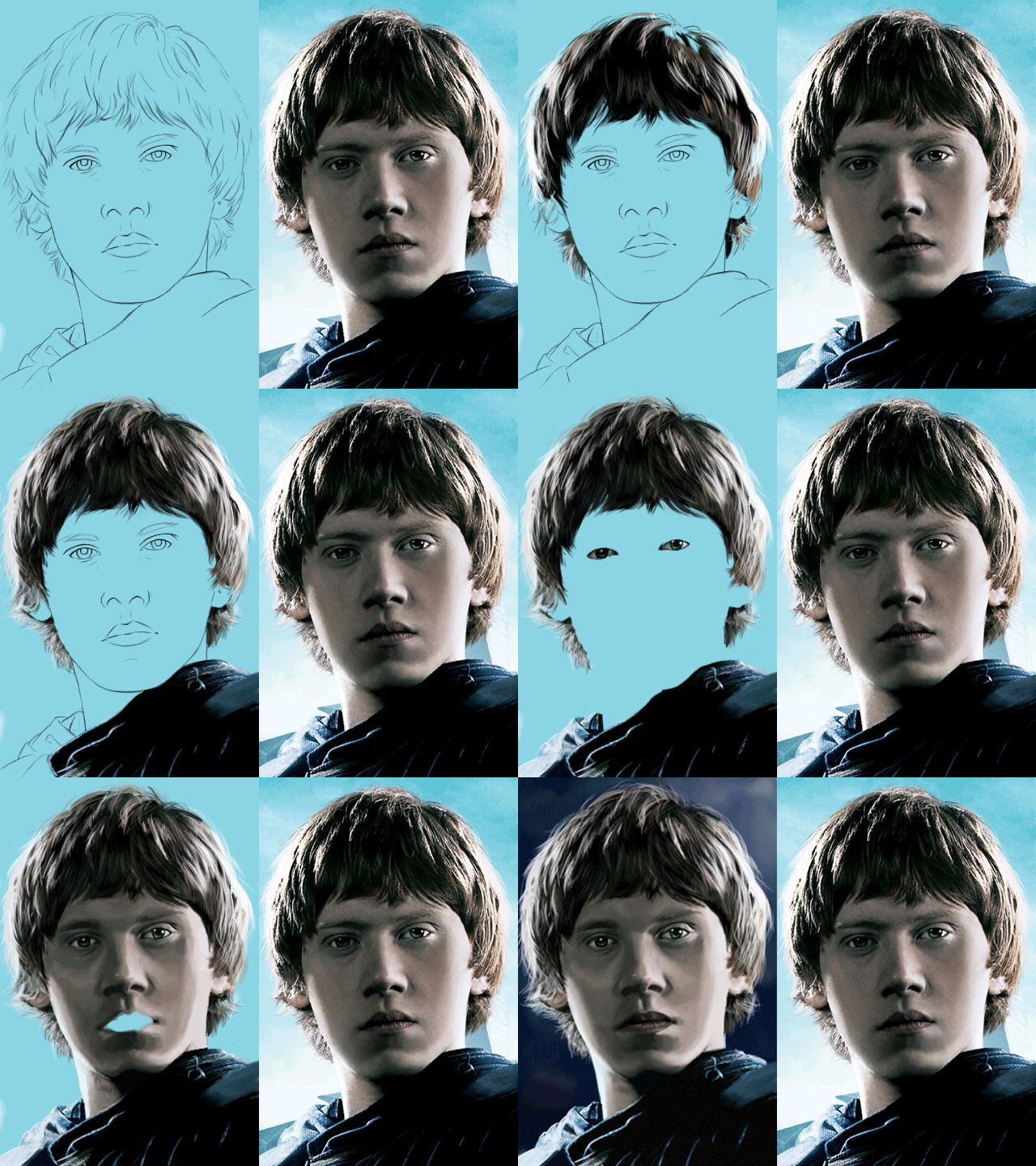
As usual, here are my efforts.

Ron Weasley: Drawing Progression

Cited Works


coldsnapkiller. (2011). 1-1.gif picture by coldsnapkiller. Retrieved December 2, 2011 from http://s1098.photobucket.com/albums/g371/coldsnapkiller/?action=view¤t=1-1.gif

deviantART. (2011). deviantART. Retrieved October 21, 2011 from http://www.deviantart.com/

Digital Citezen. (2009). Ron Weasley. Retrieved December 1. 2011 from http://digitalcitizen.ca/2009/09/03/harry-potter-wallpapers-for-iphone-and-blackberry-bold-9000-480-x-320-pixels/printable-card-from-wallpaper-41/

shley77. (2005). Painter Portrait Tutorial. Retrieved December 1, 2011 from http://shley77.deviantart.com/art/Painter-Portrait-Tutorial-21629016

shley77. (2011). shley77 on deviantART. Retrieved December 1, 2011 from http://shley77.deviantart.com/

Wednesday, November 30, 2011

Tutorial Critique 3: Eyes

I went to YouTube for this tutorial . I chose YouTube because wanted to see how a video based tutorial stacked up against one with still images. Interestingly enough, they’re quite similar, the main difference being that videos allow for audio (I would also say moving frames, but artists could use a gif for image progression). Again, I will give a little info on the artist. He went to New England Institute of Art, he has several sites that he uses to showcase his work (which in my opinion is excellent). For those interested, his sites are on YouTube, deviantART, and Blogger .

On to my critique of the tutorial.

Pros


  • He shows visual progression.

  • The text is short and concise.

  • He accepts criticism, and allows feedback from his viewers.

  • The final product looks good (in my opinion), suggesting he knows what he’s talking about.

Cons


  • The text doesn’t go too much into detail about how he does what he does.

  • From what I can tell, the tutorial is more for people who already have an understanding of how to draw an eye. So this isn’t really for beginners.

  • He skips how he did his line art, which some people might find helpful (though he does link to a previous tutorial he’s done that goes over how to draw the eye from scratch).

  • The audio consists solely of background music. This isn’t necessarily a con. Some viewers may find it enjoyable, others may not.

  • The title is a little deceptive. The tutorial is more focused on shading the eye, rather than drawing.

The tutorial is helpful, but like I said before, not for beginners. An artist has to understand how shadows and lights fall onto the eye (or any subject) for them to fully take anything from the tutorial. Although to his credit, I am not a beginner, and I don’t think I have ever drawn an eye as good I have before following this tutorial.

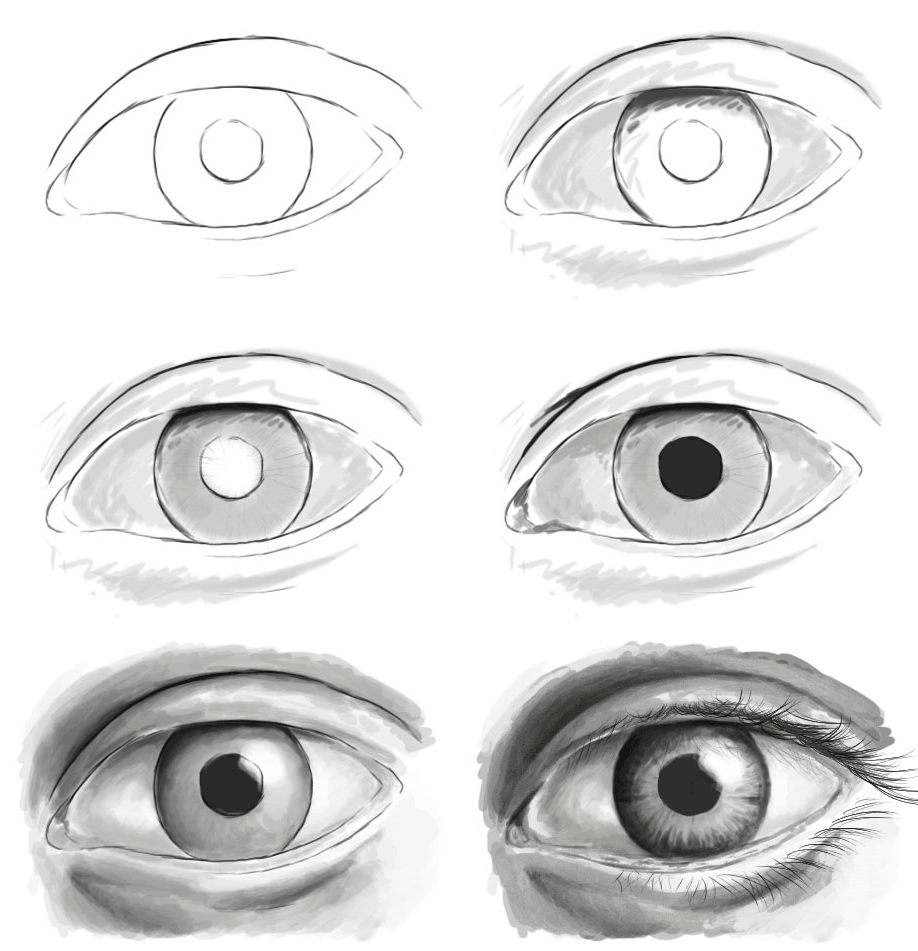
Here is my product.

Eye Progression

© All rights for the above image reserved

Cited Works


coldsnapkiller. (2011). 1.gif picture by coldsnapkiller. Retrieved November 29, 2011 from http://s1098.photobucket.com/albums/g371/coldsnapkiller/?action=view¤t=1.gif

Isaiah. (2011). Eye Drawing Tutorial. Retrieved November 29, 2011 from http://www.youtube.com/watch?v=AvKBWaOQ28M

Isaiah. (2011). IsaiahKS on deviantART. Retrieved November 29, 2011 from http://isaiahks.deviantart.com/

Isaiah. (2011). isaiah's Channel - YouTube. Retrieved November 29, 2011 from http://www.youtube.com/user/isaiahs

Isaiah. (2011). Sick Sad Story :). Retrieved November 29, 2011 from http://isaiahks.blogspot.com/

Tutorial Critique 2: Hands

The tutorial for this post will focus on hands. I chose to do a tutorial on hands because I myself have had trouble with drawing them in the past, and sometimes struggle with them today.

The particular tutorial I am following comes from a site called Rate My Drawing. The tutorial was created by KakeranoTsuki (screen name). A little on the artist—from what I could gather— she is 19 years old, and based on how long she’s been a member of the site (along with her deviantART account), she has quite a bit of experience in drawing. Given that, I trust that Tsuki has an idea of what she’s talking about in her tutorial.

Now, for my thoughts on the tutorial.

Pros

  • Her steps are short and concise, so becoming confused shouldn’t be an issue even for a beginner.
  • When she uses art jargon, like foreshortening, she explains the idea and gives examples.
  • Each step has a visual.
  • When discussing how to draw fingers, she explains how to draw for both male and female. This is good for the fact that men and women do have differently shaped fingers, so it’s essential she teach the people following her tutorial that for future use.
  • She went into detail about fingernails. It’s just a nice add on for those who want more realistic hand drawings.

Cons

  • There is no comment section, so users can’t suggest changes if any are needed. Though this is more of a site issue.

Since the tutorial has more pros than cons, I give my stamp of approval. The tutorial was effective in teaching someone how to draw hands.

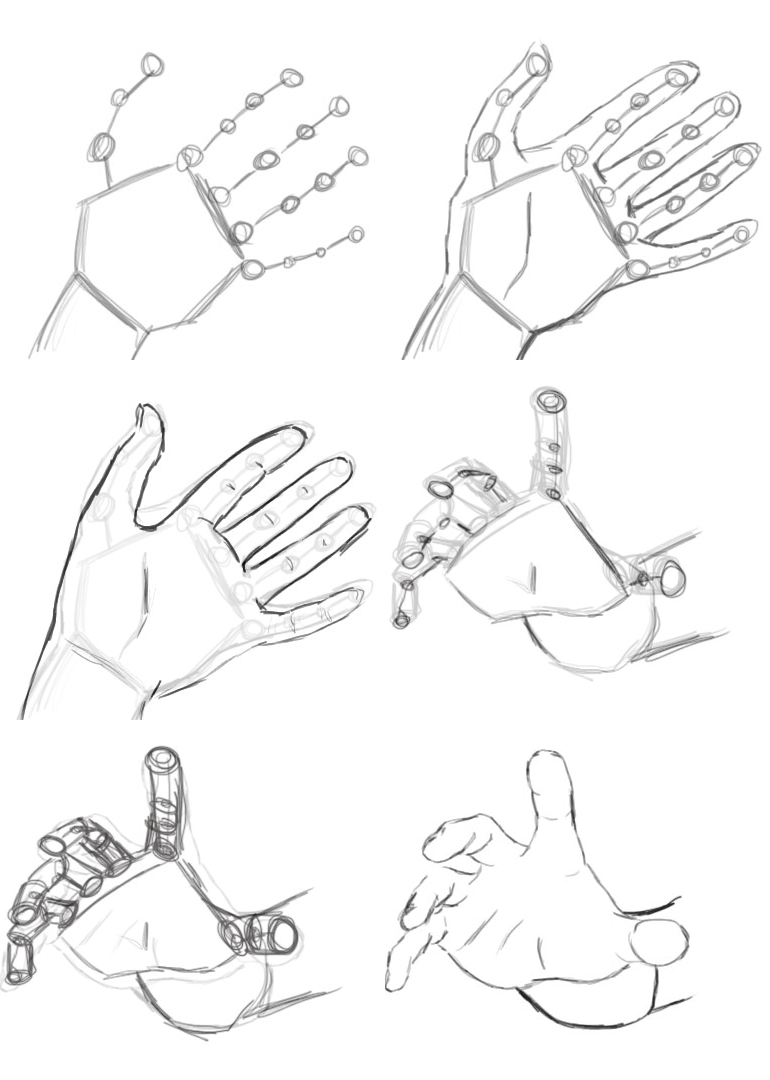
For those who are interested, here is my effort from following the tutorial.

Hand In Progress

© All rights for the above image reserved

Cited Works


coldsnapkiller. (2011). 1.gif picture by coldsnapkiller. Retrieved November 29, 2011 from http://s1098.photobucket.com/albums/g371/coldsnapkiller/?action=view¤t=hand.gif

KakeranoTsuki. (n.d.). Tips for drawing hands. Retrieved November 29, 2011 from http://www.ratemydrawings.com/tutorials/drawing/138-Tips_for_drawing_hands.html

KakeranoTsuki. (2011). KakeranoTsuki on deviantART. Retrieved November 29, 2011 from http://kakeranotsuki.deviantart.com/

Mixart New Media LLC. (2011). Rate My Drawing. Retrieved November 29, 2011 from http://www.ratemydrawings.com/index.php

Tuesday, November 29, 2011

Color Use

Tutorials for color use are one of many art tutorials available. When opting to use color in a piece the artist is presented with different challenges than they would face when dealing solely with the grey scale.

Stone says that “[o]ne ideal goal would be that the reproduction is indistinguishable from the original.” (2003, p.88) The artist has to realize that the ways colors appear in person aren’t always the way they should be transferred to paper. I have learned from teachers and from personal experience that one should not use pure green to color in the leaves, grass, or what have you. By blending “small patches” of color (particularly colors that would normally go unnoticed) can create a more realistic rendition of the subject matter. (Kuehni, 2005, p. 155)For example, skin tones are composed of more than browns, tans, and peaches—blues, reds, and greens may also be present, but because the colors are so subtle they go unnoticed.

The artist has to be aware of and consider complementary colors. Complementary colors are “colors directly opposite each other in the color spectrum”. (Oxford University Press, 2011) By blending a colors complement (red for green, yellow for purple, and blue for orange) the artist can create darker hues of the various colors. Doing this is a good alternative to using straight black.


Color can also assist when the artist is trying to convey emotion or send a message. Colors have meaning, and each color represents something. The meaning behind a color can vary from culture to culture, i.e. red can stand for rage or love, yellow could stand for happiness or caution, and so on. (Morton, 2011) (The International Business Edge, 2011) The artist has to be conscientious when deciding to use color in this manner.


Cited Works


The International Business Edge. (2011). Color Meanings by Culture. Retrieved November 28, 2011 from http://www.globalization-group.com/edge/resources/color-meanings-by-culture/

Sakurambo.(2007). Blue Yellow Red Color Wheel.[PNG Image]. Retrieved November 29, 2011 from >http://en.wikipedia.org/wiki/File:BYR_color_wheel.svg

Kuehni, Rolf G. (2005). Color an Introduction to Practice and Principles.

Morton, J.L. (2011). Color Matters. Retrieved November 29, 2011 from >http://www.colormatters.com/color-symbolism/the-meanings-of-colors

Oxford University Press. (2011). Definition of Complementary Colors from Oxford Dictionary Online. Oxford Dictionaries. Retrieved November 29, 2011, from >http://oxforddictionaries.com/definition/complementary+colors?region=us

Stone, Maureen C. (2003). A Field Guide to Digital Color.

Monday, November 28, 2011

The Human Form

In the art world, drawing the human figure is arguably one of the more difficult things an artist can learn. The human figure varies greatly from person to person, not only that but one has to understand how the human form works and moves. A human figure drawn with its head twisted around isn’t considered accurate is it? A human figure with one arm two inches shorter than the other isn’t considered in proportion, right? Of course not. Mike Mattisi says, “The human figure is full of force—no matter how still it may seem.” (2006, p. 1) Meaning the body has weight, the body has emotion, and it is up to the artist to accurately depict that when drawing the figure.

The internet is littered with a multitude of tutorials that take the time to teach a newcomer (and those with experience who simply want to learn more) to draw the human figure. Some may go to the extent to teach the artist how to draw the entire human form (Li, 2001). Artists also provide tutorials that teach other artists how to draw individual parts of the human form. (Medlej, 2009)(Julie, 2006) The broken down tutorials of the human form are for artist that have trouble (or simply want to better develop) with the individual body parts, i.e. than hands, feet, head, and so on.
There are various shortcuts to drawing the human figure that I have learned over the years such as:


  • A standing human figure is typically seven heads long (though fashion designers use eight to nine to accentuate the clothes).
  • Foot proportion can be determined by the length of the points from the wrist to the elbow.
  • The face (chin to eyebrows) is proportionate to the tip of the middle finger to the wrist.
  • Simple shapes can help establish early on what an artist wants the human figure to portray, i.e. using inverted triangles for athletic figures, or hourglasses for a more feminine feel (Mattisi, 2008, p. 72)


The human form is a complicated structure and takes time to render with satisfactory results.

Cited Works


Julie. (2006). -Foot Tutorial-. Retrieved November 28, 2011 from http://odduckoasis.deviantart.com/art/Foot-Tutorial-38271036

Li, William. (2001). Figure Drawing: Basic Pose and Construction. Retrieved November 28, 2011 from http://www.elfwood.com/farp/figure/williamlibodyconstruction.html

Mattesi, Mike. (2008). Force: Character Design from Life Drawing. Focal Press.

Mattesi, Mike. (2006). Force: Dynamic Life Drawing for Animators. Focal Press.

Medlej, Joumana. (2009). Drawing Hands. Retrieved November 28, 2011 from http://www.cedarseed.com/fire/handstut.html

Sketching

Learning how to draw has its own difficulties like any other discipline, and like any other discipline it is a good idea to jot down basic ideas. These basic ideas in the drawing world are sketches. A sketch is a “rough or unfinished drawing” which serves as a preliminary blueprint for a more finished piece. (Harper, 2011)(Oxford University Press, 2011) However, making a blueprint is only one of various purposes one can utilize sketches for. Along with the jotting ideas down for later pieces, sketches can also be used for “expression of ideas, time saving expedient, [and] detail clarification.” (Dade County Public Schools,1972) Also while one sketch can be useful “a collection of sketches is more informative.” (Edwards, 2008, p.72)Since sketching is just a rougher, quick, unfinished drawing, the steps for sketching are generally the same. Those steps being: (Wang, 2002, p.39)

  • See
  • Identify
  • Isolate
  • Simplify
  • Translate

Simply, that’s the step that sets a finished drawing from a sketch. Drawings tend to be more elaborate (a bit depending on the skill level of the artist, but generally when coming from the same artist their finished drawings are more elaborate than their sketches) —sketches are simple.

On another note, one does not always have to sketch directly from life. Sketching from memory is also acceptable. Sketching from memory presents problems that sketching from life doesn’t have. Memory sketching requires a “resourceful memory bank”. (Wang, 2002, p.85)When sketching from life something concrete can be referenced and look back to, but when doing the same from memory there are no tangible references, instead the artist has to recall imagery from past experiences and so on.

Cited Works


Dade County Public Schools, Miami, FL.(1972). Orientation, Sketching, Mechanical Drawing, Drafting Basic. :[Washington, D.C.] : Distributed by ERIC Clearinghouse

Edwards, Brian. (2008). Understanding Architecture Through Drawing. Taylor & Francis.

Harper, Douglas. (2011). Sketch. Online Etymology Dictionary. Retrieved November 28, 2011, from http://oxforddictionaries.com/definition/sketch

Oxford University Press. (2011). Definition of Sketch From Oxford Dictionary Online. Oxford Dictionaries. Retrieved November 28, 2011, from http://oxforddictionaries.com/definition/sketch

Wang, T. C. (2002). Pencil Sketching. John Wiley & Sons, Inc.

Friday, October 21, 2011

Interview 1: 'Amanda'

The following post is an interview of Amanda (for the sake of anonymity on the web I won't be revealing her real name). I considur her a credible interviewee because she has experieince in the arts. Her experience in art comes from Greiner Middle School, and Booker T. Washington High School for the Performing and Visual Arts (both are schools that specifically help develop artistic skill). The school, or rather University, that she currently attends is Southern Methodist University (SMU). At SMU, Amanda majors in engilsh; however, she continues to work on her drawing, and does so in her spare time.

Me: Do you have any experience in drawing?

Yes.

Me:How many years have you been drawing?

15 years.

Me:How many of those years would you say were spent developing the skill?

8 years.

Me:How have you applied this skill?

Mostly character design and webcomic projects.

Me:What do you think makes a good artist?

The fact that I want to improve; I feel like you can't be a good artist if you don't want to improve or listen to criticism.

Me:Do you think natural talent automatically makes someone good at art, or does it only give the person with the talent a head start?

It just gives the person a head start.

Me:Do you think practice plays a role?

Yes.

Me:Have you ever followed an art tutorial (it can be something like, a photoshop tutorial, or a literal how-to-draw tutorial)?

Yes.

Me:What specifically did they teach?

Ummm, it basically helped me improve coloring techniques, to help me remember about light sources, learn new things for certain types of art techniques I wanted to try

Me:Did you think they were helpful, and if not what would you have changed about it?

No, I think they were helpful.

Me:Did you find it easy to follow (meaning: too much or too little info)?

Yes.

Me:What do you think makes a good tutorial in general?

It has to be informative, have pictorial examples, and the artist has to have a fair amount of skill. Like, if your art is low-quality that makes you a bit less credible.

Tutorial Critique 1: Coloring

Hello, everyone. Well I thought I get the main point of my blog started, i.e raoming around for tutorials and following them. Naturally I went to deviantART to find a tutorial (I go to deviantARt a majority of the time mostly because it's familar, and I know all the navigations, etc). Anyway, there is an artist that I follow on the site. I love the way he draws, his technique reminds me of American comic books (which interestingly enough he draws covers for a comic called Morning Glories.

Now on to the tutorial. He posted what I would considur a tutorial (step by step on how to do something specific, but it should be noted that he himself was unsure whether it should be noted as a tutorial). The tutorial shows someone how he colors faces, specifically for photoshop users.

I followed the tutorial word for word. It had it's flaws, but it was also helpful.


Pros


  • It was specific about what photoshop tools to use, like whether the edges of the brush should be hard or soft, opacity of the brush, etc.


  • It gave image, and even more important mulitple images. This helps the person following the tutorial compare their own progress with his to see if they're on course.


  • He gave the specific tools that he uses in his comments, i.e. the photoshop version, and the type of tablet he uses.

  • He self corrects the tutorial based on comments he receives.

Cons


  • It didn't show how to texture the hair, although the tutorial was specific to the face (and hair tutorials tend to be seperate anyway, at least from personal experience).


  • The tutorial assumes that the person understands the concept of value, tone, and shading, meaning this is most likely for people with prier experience in drawing.


All in all I think the tutorial was effective.

And here is my final product...


© All rights for the above image reserved


Cited Works


deviantART. (2011). deviantART. Retrieved October 21, 2011 from http://www.deviantart.com/

Esquejo, Rodin. (2011). cakes on deviantART. Retrieved October 21, 2011 from http://cakes.deviantart.com/

Esquejo, Rodin. (2006). how I do a face. Retrieved October 21, 2011 from http://cakes.deviantart.com/art/how-I-do-a-face-29184892?q=gallery%3Acakes%2F6521042&qo=108

Image Comics. (2011). Morning Glories Vol. 1 HC (MR) Deluxe Collection. Retrieved October 21, 2011 from http://www.imagecomics.com/comics/4389/Morning-Glories-Vol-1-HC-MR-Deluxe-Collection

Friday, October 14, 2011

Art History

Drawing can be defined as the representation of form with the use of lines.

The history of drawing is a long one, and has been around since the existence of the human race. The earliest drawings are those found in France in Spain dating back to 30,000 to 10,000 B.C.. These drawings were found on the walls of caves (Refer to image 1). There are various speculations as to the purpose of these early drawings, with no finite answer.

image 1: An early cave painting in Lascaux, France


Naturally, like most things, drawing too has evolved over time. During the early years of drawing paper was not available. When paper did become available during the 1100s it was expensive. Drawing (or art in general) has been through many trends over the years, like the baroque period, neoclassicism, romanticism, realism, and others.

One notable era of art would be the Renaissance (beginning from around the 14th century and lasting until the 17th century). During this time there was an increase in drawings. This was mainly due to the fact that paper had become more readily available an art had been reborn as a cultural movement. Art was used to study things such as light, nature, human anatomy and so forth by many artist such as Leonardo da Vinci (Refer to image 2).

image 2: A da Vinci drawing study


Nowadays art has melded with technology to create various products, like animated movies, special effects, commercials, designs for various things, and so much more. This also means that art as become more ambiguous, meaning that art can be just about anything. Still, despite arts many stages of evolution, it is still thriving.


Cited Works


The Metropolitan Museum of Art, The Heilbrunn Timline of Art, Retrieved from The Heilbrunn Timeline of Art (14 October 2011)

Mules, Helen B.,The History of Drawing,Retrieved from The History of Drawing (13 October 2011)

Me, Myself, and My Blog

Hey everyone, my name is Michael. I am currently a college student majoring in Arts and Technology, or ATEC for those of you who like shorter words. For anyone unfamiliar with this, ATEC is basically a degree that’s focuses on video game design and animation (even more specifically it delves into the individual job applications for those career tracks, like a sound designer, special effects artist, and so on).

The degree requires that we in this major take drawing and design classes. Now, I have been drawing since I was very young—around the age of five or so (maybe younger) — and have shown an interest in the subject ever since. I mostly went off instinct and natural talent up until the 5th grade. That’s when I began to hone my skills as a visual artist.

A lot of the time I will be on sites like deviantART, and I will come across someone giving tutorials on how to draw (usually in the poster’s own style). I feel that as an artist one can always learn more about something and if I like the poster’s work I will give the tutorial a look over. Unfortunately, not every tutorial post is good at its job, i.e. teaching the audience how to do what the poster does.

This brings me to the topic of my blog. For my blog I will be looking at tutorials, specifically ones that are about art (drawing, coloring, texturing techniques, etc). I will follow the steps of the tutorial, post my results, and evaluate the pros and cons of the tutorials’ ability to teach. By doing this blog I’m hoping to both get a better understanding of what makes a good tutorial, and further my skills in visual arts.